
Is Your Protein Powder Toxic?

Consumer Reports Sounds the Alarm!
 

Consumer Reports, one of the most trusted guides for buying reputable products, has found heavy metals in protein supplements and is warning you to use caution.


Officials for consumers says it purchased 15 protein powders and drinks mainly in the New York metro area or online and tested multiple samples of each for arsenic, cadmium, lead, and mercury.


The results were very disturbing, considering how many people consume these highly processed food products and how MUCH they consume per day.


The results showed a considerable range, but levels in three products were of particular concern because they exceeded the daily exposure limits proposed by USP  for  arsenic, cadmium or lead. This is if you assume 3 servings per day which is the average for most consumers. Some eat more some eat less. For many products, levels of those contaminants were in the ‘low to moderate range’.

Personally I would not find even “low to moderate” exposure acceptable considering how many other toxic products we find in our environment. We have enough health considerations just dealing with life without wondering about a product we specifically consume for health or fitness!


Cadmium exposure is particularly scary
because it accumulates in and can damage the kidneys, the same organs that can be damaged by excessive protein consumption. It can take 20 years for the body to eliminate even half the cadmium absorbed today. 


Imagine what will happen to the large group of teenagers and twenty somethings wanting to ‘bulk up’ today.  They are the ones who eat a LOT of these products and who may be in for a very unpleasant surprise some time from now.

 
”This (Cadmium) is a highly toxic metal, and while there are some cases where decisions have to be weighed against relative risks, accepting that you have to be exposed to any cadmium at all in your protein drink after your workout is definitely not one of them.”
says Michael Harbut, M.D., director of the Environmental Cancer Initiative at the Karmanos Cancer Institute in Royal Oak, Mich.


Even some plant sources can contain cadmium by the way.  This is because of the heavy use of cadmium-containing phosphate fertilizers in commercial farming. Potatoes, rice, sunflower seeds, spinach, and other leafy greens are suceptable to this but of course this is not a problem IF you are eating organic.


Below is the average finding for three serving of the protein drinks.


You can see that Muscle Milk and EAS were the most toxic brands while the whey products faired better than the rest generally. This is just a small sampling of products.  The protein powder you buy from the store may be better but it may be worse.

You can read the complete findings (5 pages) at consumer reports.


Why Bother?


Many health experts argue that very few people need to be eating high quantities of protein to begin with, and consumer report points out  there are many protein sources from the grocery store which can supply all the protein you need that are NOT toxic.


Protein is essential in the body for our muscles obviously but also for most cell functions since it makes up enzymes, hormones and even DNA.  Most protein is recycled though, so unless you are growing rapidly or are breaking down the body a lot with extreme physical exertion,  there is not the need for a LOT of new protein. Very few people in North America are protein deficient.

 
At Real Food for Life, we like to remind everyone that you can get all your protein requirements from whole real food. Every single whole plant food has protein.


Beans, grains, seeds and sprouts have high levels of proteins but even fruits like oranges, banana,  and even watermelon have complete protein. You just have to eat more of those foods which have lower levels.  In North America, most people are generally eating a LOT of food.   If that food was whole, there is an abundance of ALL NUTRIENTS.


Copyright © Randy Fritz You are welcome to share this article with anyone who you think may benefit from this information as long as you give credit to Real Food for Life by including the link to the home page ww.RealFoodforLife.com  or the direct link to this post.

Retweet

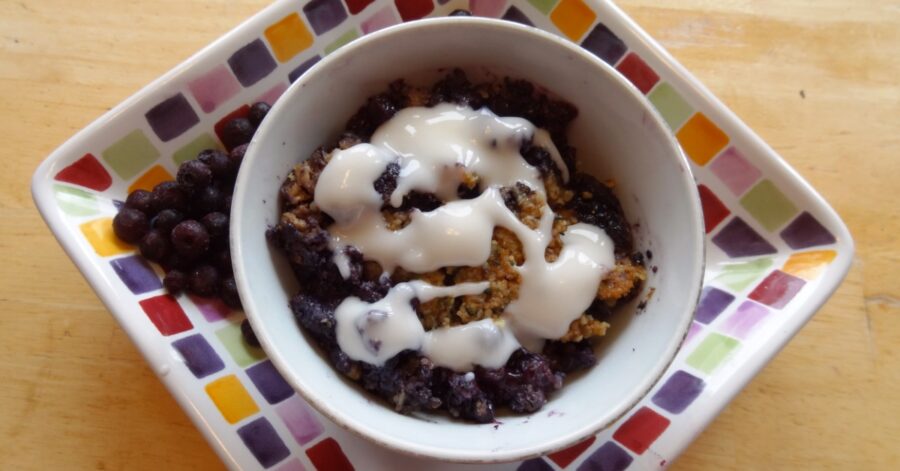
SASKATOON CRUMBLE

As you will know by reading my article: The Best Berry, Saskatoons are my favorite and I am happy to eat them just as they are.  For fun I do enjoy a crumble or pie so here is the yummy crumble recipe.

SASKATOON BERRY BASE

Ingredients:
3 cups Saskatoons
1/2 tsp Stevia – light liquid (Sunny Dew is best)
1/2 cup water

Directions:
1. Mix water and stevia together
2. Mix in berries
3. Place berry mixture in a baking dish

CRUMBLE TOPPING

Ingredients:
1 ½ cups rice flour
1 cup rolled oats
1 tsp. salt
1/3 cup vegetable oil
1/4 cup rice syrup
1/2 tsp Stevia – light liquid (Sunny Dew is best)

Directions:
1. Mix dry ingredients together
2. Mix oil, stevia and honey and add to dry ingredients.
3. Mix thoroughly.
4. Sprinkle on top of fruit
5. Bake at 350º F. oven for approximately 40 minutes.

Oatmeal Nutrition:

Oats have lots of manganese, are a very good source of selenium, vitamin B1, dietary fiber, magnesium, protein & phosphorus.
1 bowl of oatmeal a day (3 grams of soluble oat fiber) typically lowers total cholesterol by 8-23%.

Retweet

Do You Want to Help the Environment?

UN researchers reveal: One quick solution to lower our effect on the environment. 

butterfly
 
Do you know the United Nations calculated the combined climate change emissions of animals bred for their meat and found it  was more than cars, planes and all other forms of transport put together?
 
In a recent article published in July 2010 by the Guardian.co.uk, leading journalist John Vidal reported how vegetarianism may help save the world by eating less meat.
 
Behind the majority of the joints of beef or chicken on our plates is a phenomenally wasteful, land and electricity hungry system of farming that devastates forests, pollutes oceans, rivers, seas and atmosphere.
 
We mostly breed four species (chickens, cows, lambs and pigs) which need vast amounts of water and food, emit methane as well as other greenhouse gases and produce mountains of physical waste.
 
During the past year, the United nations calculated the combined climate change emissions of animals bred for their meat were about 18% of the global total – more than cars, planes and all other kinds of transport put together.
 
A Bangladeshi family living off rice, beans, vegetables and fruit may live on an acre of land or less, while the average American, who consumes around 270 pounds of meat per year, needs 20 times that.
 
Academics have calculated that if the grain fed to animals in western countries were consumed directly by people rather than animals, we could feed at least 2 times as many people – and perhaps far more – as we do now.
 
Eating a steak or a chicken points to an extreme water consumption, that the animal has required to live and grow. Vegetarian author John Robbins calculates one pound of beef needs around 20,000 lbs of water.
 
Farming, which uses 70% of water available to humans, is already in direct competition for water with cities.
 
Industrial scale agriculture now dominates the western livestock and poultry industries, and a single farm can now generate as much waste as a city.
 
Farming animals generate manure and urine which is funnelled into massive waste lagoons sometimes holding as many as 40 m gallons. These cesspools often break, leak or overflow, polluting underground water supplies and rivers with nitrogen, phosphorus and nitrates.
 
A meat diet is normally considered twice as expensive as a vegetarian one. According to the Vegetarian Society, meat eaters get increased probabilities of obesity, cancer, heart diseases and other illnesses as well as a hole in the pocket.
 
So what now? How can we start contribute save our world?
 
Here a quick and simple recipe to find a good meat substitute:

Tofu and Green Onion Veggie Burger
 
This healthy tofu based veggie burger receive an extra nutritional boost from wheat germ. This recipe is both vegetarian and vegan.
 
Ingredients:
 
 * 1/2 container firm or extra firm tofu, mashed
 * 1 onion, diced
 * 3 green onions, diced
 * 2 tbs wheat germ
 * 2 tbsp flour
 * 2 tbs garlic powder
 * 2 tbls soy sauce
 * dash pepper
 * oil for frying
 
Preparation:
Mix all ingredients in a large bowl. Form into patties.
Fry patties in oil in a large skillet until brown and crisp, about 10 minutes.
 
Now it's all to you…
 
About the Author – Martha Volz writes for the  http://www.vegetariansupplements.org  her personal passion blog related to vegetarian healthy eating ideas.

P.S.  from Randy -  Martha contacted Real Food For Life after reading our Nice Cow, Baaad Cow article . You can see it contains many of the same ideas.  I'd like to hope that great minds think alike!

Retweet

Saskatoons are the Best Berries!

What is YOUR favorite berry? 

Mine certainly is the Saskatoon and I go out picking them as soon as they are ripe. I freeze lots of them to last the whole winter.  If you cannot pick them; you will often find them in farmer's markets. 

When we were children my father would load all of us into his pickup truck with buckets for all and we would go out saskatoon hunting. We would always come back with many full tummies and buckets. Back then my mother would perserve dozens of jars of them for us to eat in the winter. Now I freeze them which is easier and more nutritious. Still I fondly remember those delicious jars of saskatoons my mother made for us; so delicious.

 
Saskatoons that I picked.
 
Our Saskatoon is a very hardy plant for the northern climate as it survives low temperatures and drought, and can live poor soil. It has the capacity to be productive for many years.   A couple of years ago I planted two bushes in my front yard and there are other wonderful things about them. They are full of showy flowers in the spring, and then has beautiful leaves in the fall. Saskatoons
 
For the North American Indian people, saskatoons were a staple food. Often the tribes held ceremonies and feasts to celebrate the beginning of the saskatoon harvest.  The Cree name for this plant is "mis-ask-quah-toomina," which early settlers shortened to"saskatoon."
 
In parts of the NW US & Europe Saskatoons are called June Berries, Service Berries or Shadbush.
 
Settlers to our country saw the potential of these berries being added to their diet. Also note that they were an important food source during the depression in the 1930’s. So why not add these free berries to your diet.
 
Saskatoons will supply you with important nutrients as well as being so yummy!
 
Nutrients in saskatoon berries.
A 100 gram serving of saskatoon will supply:
  • 22.3% of recommended daily iron
  • 244 mg of potassium or 10% of daily needs
  • 88 mg or 11% of daily calcium requirements
  • 20% of carotene
  • 16 mg of Vitamin C
  • 2.5% of zinc and 33.8% of manganese
  • 32 mg of phosphorus or 1.1%
The berries were also used to treat liver trouble and as a laxative, and the inner bark or roots were a remedy for diarrhea.DSCN1890
 
What do they taste like?  This of course is a difficult question to answer. Although similar to blueberries, they have a fuller flavour and have slightly crunchy tiny almond-flavoured seeds inside.
  
Picking saskatoons:  pick the berries that are most purple as these are the ones that are ripe and sweet. The branches bend down allowing one to reach higher berries .
 
I will post some of my recipes soon. :)

Copyright © Diana Herrington  You are welcome to share this article with anyone who you think may benefit from this information as long as you give credit to Real Food for Life by including the link to the home page www.RealFoodforLife.com  or the direct link to this post.

Retweet
<