

 I’ve had an on /off relationship with weeds recently (see Dandelion Madness) and now I’m at it again.
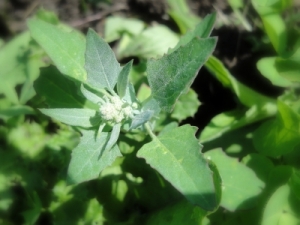
My attention has now gone to yet another weed called Lamb’s Quarters.
This one’s not so pesky to your lawn and it tastes much better. Actually it tastes almost exactly like spinach – particularly when cooked – and again, it has all kinds of nutritional value and … it’s free.
You can also call it Fat Hen, Nickel Greens, pig weed, dung weed or White Goosefoot. Some of these names I also don’t love.
Benefits and Facts about Lamb’s Quarters
- If allowed to mature, Lamb’s Quarters produces a head of thousands of black tiny seeds.
- Seeds are highly nutritious since it’s species is closely related to the superfood, Quinoa
- It has been eaten, perhaps unknowingly, since the iron age.
- One cup raw leaves contianes 11,600 IU of Vitamin A
- Also high in Vit C, phosphorus, Calcium, Riboblavin and Iron.
It now grows wild in North America – and probably most people unknowingly just pull it out of the garden. You can recognize the plant when young because the center of the top is feathery looking with a purple tint. The picture is of a younger plant.
Caution:
Like every food and plant – there is no PERFECT food that is 100% good. There is always some small (or big) aspect that is not good for the body.
That is why it is best to eat a large variety of foods and to know how to combine and prepare foods properly so that that negative effect is reduced.
Greens have such high levels of so many nutrients that it is not surprising that this particular green has its own particular problem . This means you shouldn’t eat TOO much of it. This is not likely considering how little people eat weeds but just so you know – it has high levels of oxalic acids in it. Oxalic acid can bind with other minerals in the body causing mineral depletion and in its worse case – kidney stones. Many foods contain this ingredient so if you are even relatively healthy there is not cause for concern.
A few raw cups of this thrown in your salad therefor is no problem – or even if you ate several cups cooked but if you were using it a lot over a long period of time than be aware. If suddenly you are NOT attracted to eating it – follow that advise from your body and take a vacation. I personally liked it best when the plants were just big enough to have a head of green seeds. Seeds contain all the vitality of the whole plant. When green and steamed they have a very delicate flavor. When they start to get brown they have a much stronger taste.
The season is getting along but I encourage you to find some young plants and try it out. You may like it ……..and of course its free!
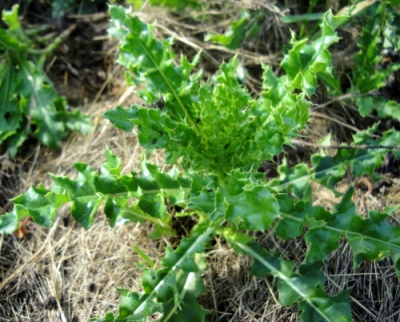 Canadian Thistle
Another weed grows in my garden in my garden even better than Lamb’s Quarters. I won’t mention its many nutritional qualities now.
No this is really just a rant.
This name ‘Canadian Thistle’ is even more inappropriate than the previous weed. There is NOTHING Canadian about this weed. Canadians are polite and friendly and always saying ‘sorry’ and ‘eh’.
This weed doesn’t say anything even when it pricks you with its MILLIONS of prickles and overruns your garden. It can also be called the creeping thistle.
I am told that you can eat the leaves and the root. I tried and wrote about it in The Man Who Tired to Eat Thistle. If any of you have tried please let me know how it turns out!
I’d rather hear though, about some ingenious way to get rid of this (or make peace with it) since it is now my garden’s worse invader.
I used to think this weed was a ‘wimp’ because I could very easily weed whip it down from large patches around the farm. It has a large hollow stem so I could easily get cut away but now I am pulling up younger plants from my garden and it is the most difficult. Any suggestions?
Feel free to share this post with anyone or leave your comments below.
P.S. If you thought “Good Weed, Bad Weed” had anything to do with the consumption of illegal recreation substances then your head is definitely in the 60’s!

Subscribe to the Newsletter
Get healthy tasty vegan gluten-free recipes and useful lifestyle tips sent to you twice a month
Pig weed is great as a spinach substitute in quiche.
Thistle roots are good when pealed. They are mild in taste and make a pretty good substitute for celery in cooking. They can be eaten raw or cooked.
Thanks! You explaining the thistle root has inspired me. The roots are certainly big enough!
Randy, I used to take my boot and step the thistle plant over so the top of the root area was exposed and then with my fingers pull just the root kinda out and up with the top of the plant still stepped down. Worked real well especially in tilled areas. That way one didn’t get pricked by the thistle.
Thanks. With all this encouragement I might even try these roots out!
We picked and cooked pig weed on the farm for years. That along with milk (YUK!} was a major part of our diet. Now THAT is good weed, bad cow!
Hi Randy and Diana,
Someone said that pouring hot water over them might kill them, or just lopping off the tops to discourage their growth. I personally haven’t found these methods work, nor does pulling the main plant out by the root, since it usually has other smaller roots which have migrated from the main plant. It’s important to find them all. One year we had our 3 acres sprayed with something was not toxic and this kept some down, but they return if you don’t get them all! Good luck!
Hi, –everything has a enviromently friendly enemy. It just needs to be tested to find the solution. I have not looked at this weed for extermination, but I am sure it can be done now that the tought has surfaced. Thanks–I will look into it.
Roundup extended control works, but you have to spray a LOT.
Thanks for the suggestion.
Actually, the thistle is an incredibly nutritious and rather yummy weed, too, believe it or not! You munch it up in a blender with water and a bit of mint, strain it (unless you have a high speed blender which can pulverize the thistles), then drink and oh my, it’s indescriably vitalizing. Tastes like a combination of cucumber and wheatgrass with a hint of mint (from the mint you add for freshness and flavour).
A herbalist friend of mine turned me on to this. Here’s to the thistle!
You have inspired ME!
Just be sure not to use the flowers, they’re too woody. I live in a place with no thistle growing (horses eat everything) and I really miss my thistle drink.
How do I get in touch with the original author of this article. I would like to publish it in our local non-profit newspaper (501c3) . We are located in southern Oregon. The name of the paper is The Applegater. The paper is given out freely to all the residents of the Applegate valley. I am the garden writer for the paper but this little article says what I wanted to write about this time. I would like to publish it with full permission from the author and use his full name and contact. There is no money charged for the paper and all none of the writers are paid. Thanks for your help. Sioux Rogers
I remember as a kid the cows would eat all the thistles they could. Borrow a cow and let them have at it but beware they will probably eat your other plants also.
Good idea. Does anyone out there have a cow I could borrow? : )
Reading this I believed it was incredibly enlightening. I value you bothering and effort to put this post together. Once again I discover myself shelling out excessively enough time both studying as well as commenting. But so what, it had been nevertheless worth it!
so then does this go for all the Thistle plants because I’ve seen alot of other ones or are they different and i can’t eat them, what im saying is that is it ok to eat the ones thats not “milk-Thistle” but they look just like the “milk Thistle” plants i see alot of “spear Thistle” plants where i live.
Thought you might like to know a bit more about Canadian Thistle as an indicator of soil type and perhaps ‘deficiencies’ that can be changed or corrected to stop it coming back: http://homestead.org/DianaBarker/LooktotheWeed/SoilIndicators.htm
However, if the root tastes as good as you say, you might not want to get rid of it! Anyway, I found the above article very helpful for information about the reasons why certain weeds grow in some places and not others and what to do if a change or non-herbicide option for control is desired. Thanks!
Thanks Eri for that link! Much appreciated.